

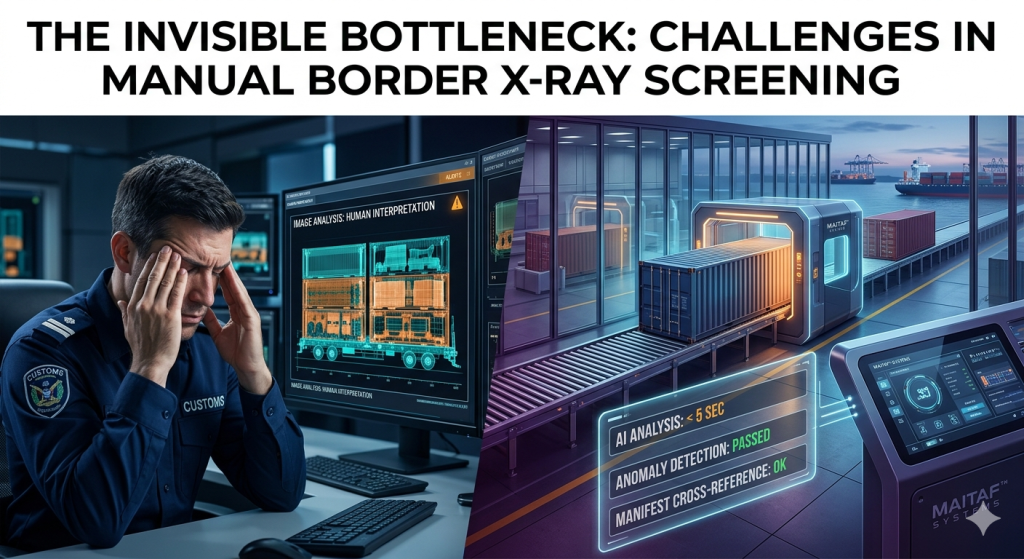
In global trade, the border is a high-stakes balancing act. Border agencies and customs authorities are tasked with two conflicting mandates: facilitate the rapid movement of legitimate cargo to keep the economy moving, and rigorously inspect shipments to stop illicit goods, smuggling, and trade fraud.
Non-Intrusive Inspection (NII) technology, specifically high-energy cargo X-ray systems, was supposed to solve this problem. However, equipment is only as good as the eyes interpreting the data. Today, reliance on manual border X-ray screening has become one of the most significant operational and security vulnerabilities in modern supply chains.
Here is a look at the critical challenges plaguing manual cargo screening—and why the industry is rapidly moving toward autonomous, AI-driven alternatives.
1. The Human Cognitive Limit: Screen Fatigue
Scanning a standard shipping container or air cargo pallet generates highly complex, dense, and dual-energy X-ray images. Human operators must scrutinize these images for anomalies, hidden compartments, and mismatched cargo manifests.
Studies show that after just 20 to 30 minutes of continuous image review, a human operator’s detection rate drops significantly due to cognitive fatigue. Visual boredom and eye strain lead to missed threats, meaning contraband slips through simply because an operator blinked or had been on shift too long.
2. The Speed vs. Security Paradox
Time is money in international logistics. Ports and border crossings face immense pressure to minimize dwell times. When X-ray analysis relies purely on human interpretation, it creates a severe bottleneck:
- If operators take the time to thoroughly audit a complex image, port congestion spikes.
- If operators rush to meet throughput targets, the quality of the security check is severely compromised.
This forced trade-off between border throughput and national security is a systemic flaw that manual screening cannot fix.
3. High Operational and Training Costs
Interpreting forensic-grade X-ray images is a highly specialized skill. Training a customs officer to become a proficient image analyst takes months of expensive training and years of on-the-job experience.
Furthermore, high staff turnover rates mean agencies are caught in a perpetual cycle of recruiting and retraining, draining valuable state resources.
4. Subjectivity and Lack of Standardization
Two different human operators looking at the same X-ray image can come to completely different conclusions. One might flag an organic mass as suspicious, while another might pass it through as standard commercial goods.
This lack of standardization creates unpredictable border vulnerability. It also makes manual screening highly susceptible to insider threats and corruption, as a bad actor only needs to bypass a single human decision-maker.
5. Disconnection from Manifest Data
An X-ray image does not exist in a vacuum; it must match what is legally declared on the customs manifest. In a manual workflow, cross-referencing a complex image with hundreds of lines of statutory declaration data is tedious and slow. Analysts frequently fail to spot clever “mismatch anomalies”—such as a dense cargo mass that does not align with the weight or material declared on the shipping paperwork.
Beyond the Human Eye: The Autonomous Solution
The fundamental challenges in manual border X-ray screening stem from human limitations, not human effort. The volume of modern trade has simply outgrown the capacity of manual oversight.
AI doesn’t suffer from fatigue, doesn’t feel the pressure of port queues, and applies the same rigorous, forensic-grade scrutiny to the first container of the day as it does to the ten-thousandth.
Ready to eliminate the vulnerabilities of manual screening? Discover how MAITAF™ is pioneering zero-human-interference border intelligence.